A
The process lives in the heads of a few people.
As long as everything runs smoothly, you don't notice. But when someone leaves or a new colleague joins, it turns out how much knowledge is written down nowhere.
Many SMEs buy software on top of a way of working that nobody fully understands. Together with you, we map your business processes as an independent partner, so you know what to tackle before you buy anything.
Four situations in which SMEs call us. If you recognise one, this is the right place to start.
As long as everything runs smoothly, you don't notice. But when someone leaves or a new colleague joins, it turns out how much knowledge is written down nowhere.
Without a shared picture, variants of the same process appear. That means double work and makes mistakes hard to trace.
Every department knows its own part, but where the process passes from one to the next, it often gets stuck. That's exactly where the gain is.
Software builds on your process. If that process is unclear, you automate the chaos instead of solving it.
No heavyweight model, but a pragmatic approach your team recognises straight away. This is how we do it together.
We bring together a small group of people who actually do the work. They know the practice; we ask the questions that make the whole visible.
A handful of steps per process, no more. For each step we record what triggers it, what it delivers and who owns it.
It's only right when everyone recognises the same picture. That avoids arguments about definitions and exposes the bottlenecks in the same place.
Together we pick a few high-impact changes, rather than everything at once. Only then comes the question of which tools really add value.
Below you'll find what we do and what we deliberately leave out.
A clear drawing your team recognises and uses.
A thick process manual full of notation that nobody opens after a month.
First understand how you work, only then look at solutions.
Buying software on top of a process nobody fully understands.
Independent advice on what you need.
An approach that just happens to always end up with one supplier.
Missing one? Call or email us. We answer without the sales pitch.
Another question? Book a call
No heavyweight model. A simple drawing that's correct and that your team recognises matters more than a perfect diagram. If a light notation helps, we use it, but the shared picture is the goal.
A first picture of the processes is often ready after a few sessions. More complex projects take longer, but you quickly have something usable in hand.
Quite the opposite. In a small team, a lot of knowledge sits in a few heads. Capturing it is exactly what protects you when someone leaves or when you bring new people on board.
This is the step before the software. If you understand your processes first, you choose more precisely afterwards and avoid expensive wrong purchases. See also our approach to digital transformation.
No, and that's deliberate. We earn nothing from the tools you end up choosing, so our advice serves only your interests.
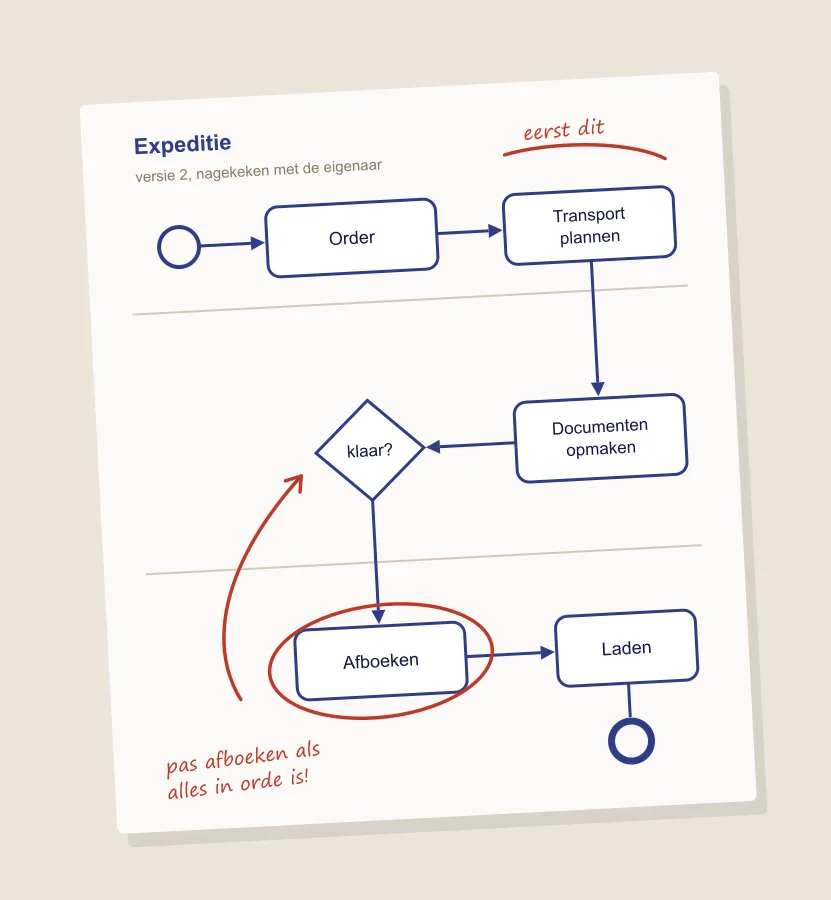
A Belgian manufacturer was moving to a new ERPEén systeem dat je kernprocessen zoals voorraad, boekhouding en orders samenbrengt. and warehouse system, but nobody had drawn the processes from start to finish. For each process we held a workshop with the owner. AI turned the recording into a first version of the flow, which we then printed and walked through with the owner. Within four weeks, nineteen flows had been approved.
“That came out of the flows. A colleague expected something that had never been in the specifications, so it had never been built. We saw straight away the gap between what we had asked for and what the shop floor expected.”