A
The system is designed, but does it match how we work?
The design described what the software had to do. How an order moves through the business from start to finish was written down nowhere.
A Belgian manufacturer was moving to a new ERPEén systeem dat je kernprocessen zoals voorraad, boekhouding en orders samenbrengt. and warehouse system. The design was ready, but nobody had drawn the processes from start to finish. With AI as a writing aid, we mapped nineteen of the twenty-four in four weeks, together with the people who carry them out every day.
From goods-in to dispatch, each with one owner at the client.
Nineteen of them were done after four weeks, drawn and approved by the owners themselves, not by us.
Processes the new system doesn't change. Drawing them would have been a waste of time.
From the recording of each workshop, AI produced a first version of the flow. Our hours went into listening and checking, not drawing. That makes it faster, and so cheaper.
The project had a functional design and a supplier who knew what to build. What was missing was a picture of how the work actually runs today.
The design described what the software had to do. How an order moves through the business from start to finish was written down nowhere.
The people on the shop floor and in the office knew who does what and when. None of it was on paper.
Planning, batch numbers and certificates were tracked and passed on by hand. What the new system would take over from that was unclear.

What have I seen far too often in the past? A project like this starts and nobody looks at the processes.
No heavyweight model. A fixed way of working that the people on the floor recognised straight away.
We listed all the processes, twenty-four in total, and found one owner at the client for each. That owner signs off the flow afterwards, not us.
One workshop per process with the owner and the people who do the work. We recorded the conversations. AI turned the recording into a first version of the flow, and we worked it out. That way the time went into listening, not drawing.
Each flow was printed and walked through step by step with the owner. Anything that was wrong was marked on the spot and redrawn, until the owner said it was right.
For each process we assessed the impact of the new system. Open points became work for the supplier, and the flows went to one central place where everyone can look them up.
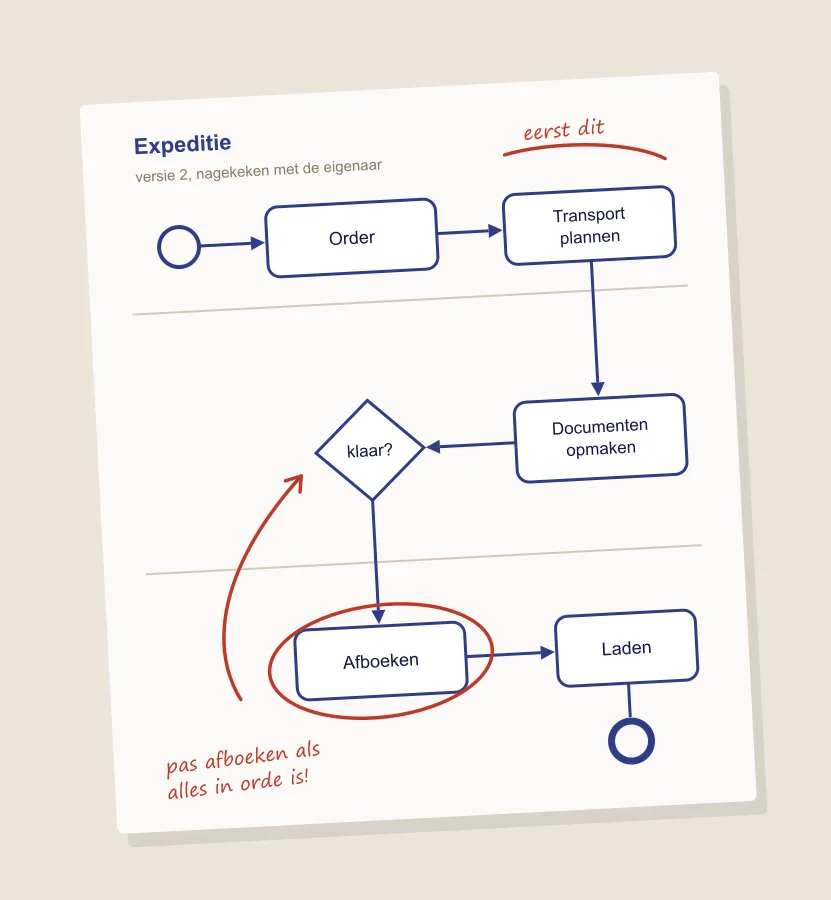
A design describes what the software has to do. A flow shows how the work runs today. Only when you put the two side by side do you see where they clash. A few examples:
A step was in the wrong order. In the design, stock was booked out before the paperwork was ready. In practice it's the other way round: stock is only booked out once all the documents are in order. Transport planning also turned out to belong at the start, not the end.
A blocked batch was only half blocked. When a batch was blocked in one system, it wasn't automatically blocked in the other. In this industry, that's no detail.
A flow nobody recognised. The way item data moved between the systems had been drawn wrongly. You only see that when the people who work with it read the flow. It was redrawn.
New scope, deliberately parked. During the workshops a registration surfaced that the design didn't account for. The steering committee decided to deliberately move it to later, rather than slip it in unnoticed.
We brought the method and the writing. The knowledge and the final say stayed with the client.
The structure and the writing.
The knowledge and the final say.
The flows didn't end up in a binder. The system is now in use, and the flows serve as the basis for testing, for training new staff and as information for partners and suppliers.
“That came out of the flows. A colleague expected something that had never been in the specifications, so it had never been built. We saw straight away the gap between what we had asked for and what the shop floor expected.”