
Blog · SME practice
What does the Digitalisation Barometer give you?
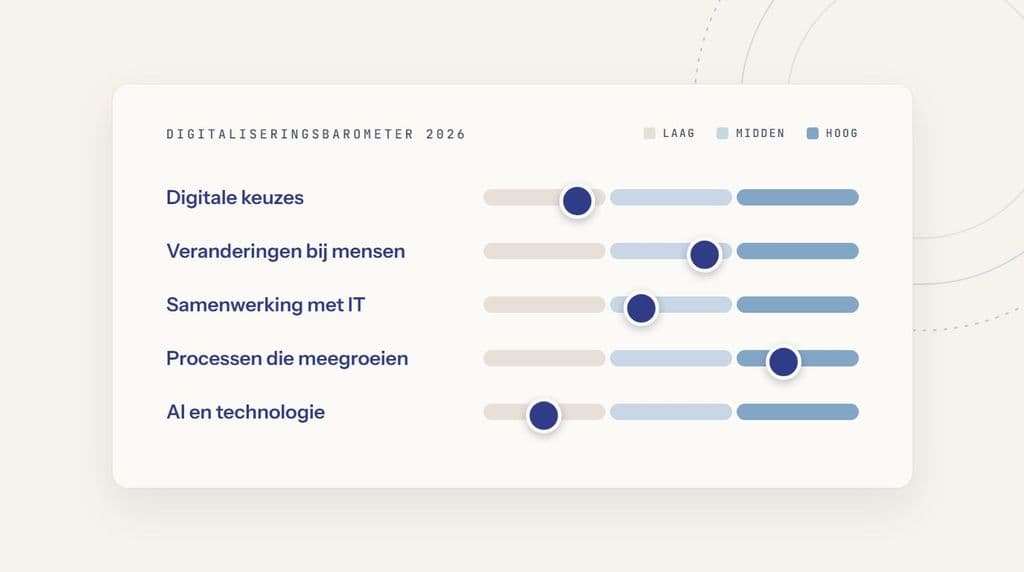
Many companies know what their last digitalisation project cost, but not where they stand today. The Digitalisation Barometer 2026 gives you a first answer in five minutes, and for each topic you can read here which step to take next.
I often see companies that know exactly what their last digitalisationConverting paper-based or manual processes into digital ones. project cost, but cannot say where they stand with their digitalisation today, or where the next step should be.
In an SME there is rarely anyone who has the time for that. The day-to-day work comes first, and as long as everything more or less runs, nobody asks the question.
That is what the Make IT So Digitalisation Barometer 2026 is for. It runs from 26 October to 22 November inclusive, and it gives you a first answer in five minutes.
What you get back
Straight after you finish: your score per topic. You don't see one figure for your whole company, but where you are strong and where there is room to improve. That is the most useful part straight away.
With your email address: your personal analysis. If you leave your address, you receive an analysis of your own answers. The address is optional, and we only use it to send you the analysis and the report. No newsletter, no sales emails.
In December: the report. In it we share what all participants show together. You can then set your own score alongside that of other Belgian SMEs. We never publish the answers of a single company.
What to do with your score, topic by topic
The barometer measures five topics. For each topic you can read below what a low, a medium and a high score usually means, and which step to take next. Start with the topic where you score lowest.
1. How you make digital choices
This topic is about who decides which software is used or how it should be built, and on what basis.
Low score. Choices are made ad hoc. A department buys a tool because it needed one, or the last supplier to drop by decides which software is used or how it should be built. After a few years you have tools that half do the same thing, and nobody who still knows why they are there.
The first step is small: make a list of which systems there are, who owns them and what they cost per year. Then make sure no new software is added for the time being, until you have a decision-making body that has the overview.
Medium score. There is a decision-making body, but every choice stands on its own. Decisions are made project by project, without a picture of where the company wants to be in two or three years.
Have that decision-making body put the most important decisions for the coming years on a single A4 page, in an order your team understands. Then, for every new choice, agree beforehand on the criteria for the decision, and make sure the key userAn employee who knows a new system thoroughly and helps colleagues get started. and the person responsible for IT sit on that body alongside the sponsorThe senior manager who gives a project backing and priority..
High score. Choices follow a plan everyone knows. The risk now is that the plan stays put while the company changes. Review it at least once a year against what has changed in the meantime: new customers, new services, new people. And for big choices, now and then ask someone from outside with no stake in the outcome to take a look.
2. How change lands with people
This topic is about what happens after a new system or a new way of working has been delivered.
Low score. Systems are delivered, training follows, and a few weeks later people simply go back to Excel. People work around the system instead of with it.
Involve the key users at the drawing board, before the choice is made, and not only at the training. Those who helped choose know why the system is there and know its limitations. Then, for each change, appoint one point of contact on the shop floor, someone colleagues can turn to when something is unclear.
Medium score. People are involved and trained, but after go-live it fades. Nobody checks any more whether the system is used as intended. A few weeks after each go-live, plan a moment to look at what people really do: which steps they skip, where they still work on paper or in emails. Adjust the process or the system to what you see, and show that you are doing so.
High score. Change lands, and people really work with the systems. The next step is for them to make the improvements themselves. Give the key users a fixed place and a fixed rhythm to make suggestions, and make sure something is done with them. An organisation where the users help steer no longer has to sell its changes.
3. How the collaboration with IT works
This topic is about your in-house IT lead and your external partners, such as the ERP partner, the web agency or the hosting partner.
Low score. IT gets a call when something is broken. There are no fixed agreements, and each partner works separately from the others.
Start with one person on your side who is the point of contact for all IT partners. Then plan a fixed monthly meeting with the main partner, even when everything is going well. That meeting is where you look ahead together, instead of only solving problems.
Medium score. The relationship with each partner on its own is good, but the partners hardly know each other. One works as far as he can within his own part, the other had planned his people in but has to replan because he is waiting for the other or for you. Make sure the partners know the long-term objective as a team, and bring them together around one shared schedule. Work with a fixed cadence and fixed meetings where everyone focuses on that one project, and make visible who has to deliver what and when, including what you have to deliver yourselves.
High score. IT and partners work well together on current projects. The next step is for them to help think about where the company is heading.
Share your objectives for the coming years with your main partners, so they can plan ahead instead of reacting. Also involve IT in strategic decisions before they are made.
4. Whether your processes grow with the company
This topic is about what happens to your processes and systems when the company changes.
Low score. The processes were set up once and have hardly changed since. The company has grown, customers arrived with other requirements, and people have built workarounds around them.
Choose one core process, for example from order to invoice, and draw how it really runs today, workarounds included. It often turns out that the problem is not in the system, but in information that sits in the wrong place or with the wrong person. Then make sure every core process gets an owner who decides what changes in it.
Medium score. Processes are adjusted, but only when there is no other way. Then a lot has to change at once, under time pressure.
Set aside a fixed rhythm and a fixed budget to improve processes and systems, even when everything is going well. Small steps every quarter are cheaper and safer than a big leap every few years.
High score. Improving is a fixed habit. Now make sure you know whether it pays off. Measure a few things that matter to the company, such as the lead time of an order or the number of manual steps, and link your improvements to what the company wants to achieve in the coming years.
5. How you use AI and modern technology
This topic is about how far AI and new technology have made it into the daily work.
Low score. AI is not used, or a few people use a public tool on their own initiative. Nobody knows what may and may not go into it. First make agreements: which tools are allowed, and which data never goes into them, such as customer data or quotes. Then choose one recurring task that takes a lot of time, and let a few people experiment with it for a month.
Medium score. People are experimenting, but separately and without knowing what it delivers. Choose one process and measure beforehand how much time it takes. Also look at the data AI has to work on: if it is incomplete or scattered, AI gives incomplete answers too. Shit in, shit out: that applies to AI just as much.
High score. AI is in a few processes and saves demonstrable time. The next step is to rethink the process itself, with AI as the starting point, instead of adding AI to a process designed for people. Start with the process that now has the most manual steps.
You don't have to improve on all five topics at once. Choose the topic with the lowest score and take one step there this quarter.

