
Blog · Leadership & team
Why I'd rather see mistakes than no mistakes.
I love mistakes. Not because I like to see things go wrong, but because a mistake means someone tried something whose outcome wasn't settled in advance. With two conditions.
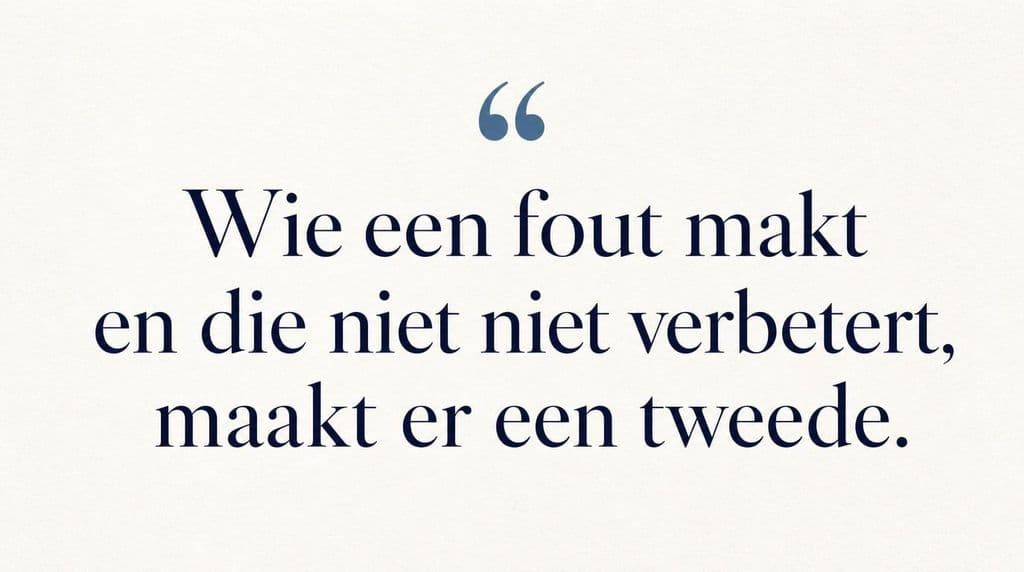
I love mistakes. Not because I like to see things go wrong, but because a mistake gives something away: someone tried, and the outcome wasn't settled in advance. People who never make mistakes are only doing what they already know how to do. And that is how a team grinds to a halt without noticing.
In a digitalisationHelping your organisation work smarter with technology, not as an IT project but as a way of working. project, that isn't just a nice theory. You choose an approach, a sequence, a supplier, and sometimes it turns out afterwards that it should have been done differently. That comes with the territory. There are always mistakes. What counts is what you do with them.
For me, that is where the dividing line lies. A mistake you understand and correct is a gain: you know something today that you didn't know yesterday, and it has cost you no more than the effort of taking an honest look. A mistake you leave lying around is the start of a second one. An old saying puts it in a nutshell: if you make a mistake and don't correct it, you have made a second one.
So my love of mistakes comes with two conditions. They mustn't repeat themselves: one wrong estimate is learning, the same estimate three times in a row is a pattern. And something has to come out of them, an adjustment or an insight that you carry into the next time. A mistake without a lesson is just damage.
The fact that correcting early pays off so well isn't a gut feeling, by the way. There is a name for it: Boehm's lawBoehm's law says that an error becomes more expensive the later you discover and fix it, and that the cost rises exponentially.. The later you find a mistake, the more expensive it becomes, and the cost doesn't rise in a straight line but exponentially. A wrong assumption that you put right in a meeting costsMeeting cost is what all the meetings cost your organisation: the person-hours that go into meetings, multiplied by what an hour costs. a conversation. The same assumption, surfacing only once it reaches the users, costs many times more.
What strikes me most is what a culture does with mistakes. Where mistakes are punished, they don't disappear. They only disappear from view. People cover themselves and hold back bad news until it can no longer be hidden, and by then the cheap mistake has become an expensive problem. Where a mistake can simply be put on the table, you hear about it early and can correct course before it costs money.
That's why I always include what didn't work in our Friday report, not just what moved forward. I admit it would make more pleasant reading without it, but a report that contains only good news is worthless. You can't steer a project on the things that went well by themselves.
And when I assess someone, I don't look for a record without mistakes. That record doesn't exist, or it means the person never dared to take on anything difficult. I look at how someone dealt with the mistake they did make. Did they spot it themselves? Did they say so? Did they fix it? That tells me more than ten projects that happened to go smoothly.
So let the mistakes come. As long as they are new and you do something about them, they are the best proof that you are still trying something.
Take another look at the image at the top, by the way. There are two mistakes in it, and I put them there deliberately to catch the eye. If you spotted them, you have already grasped the point: a mistake you can see is a mistake you can fix.


