Blog · Strategy & transformation
Digitisation, digitalisation or digital transformation: which step are you actually taking?
Digitisation, digitalisation and digital transformation sound like three forms of the same word, but they are three different steps. I explain them using the delivery note, along with what you pay and get back at each step.
In conversations with customers and partners, I very often hear digitisationConverting information from paper into a digital file. The delivery note becomes a PDF, but the work itself does not change., digitalisationConverting paper-based or manual processes into digital ones. and digital transformationHelping your organisation work smarter with technology, not as an IT project but as a way of working. used interchangeably. That is understandable, because they sound like three forms of the same word.
Yet they describe three different steps, and what you pay and what you get back differs with each step. I explain them using one piece of paper that everyone who delivers goods knows: the delivery note.
How it works today
The driver drops off the goods, the customer signs the delivery note, and in the evening that note goes back to the office. There, someone retypes the details into the accounting package so the invoice can go out. If something is not right, a quantity or a price, that colleague usually spots it while retyping and gives the customer or the warehouse a quick call.
Digitisation: the note becomes a PDF
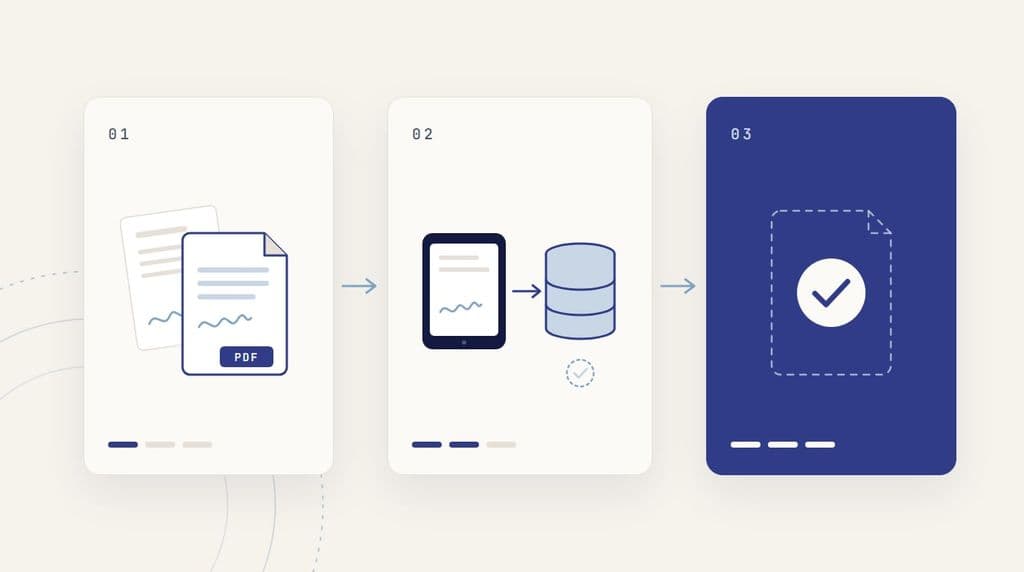
With digitisation, you convert information from paper into a digital file. The signed note is scanned and stored as a PDF. The information is now digital, but the work itself does not change. The driver fills in the same note, and at the office someone still retypes it, now from a screen instead of from a sheet of paper.
That is certainly useful. You find a note faster when a customer disputes a delivery, you lose fewer of them and your archive no longer takes up a cupboard. But don't expect it to save time, because retyping a PDF takes just as long as retyping a paper note.
Digitalisation: the note runs through a system
With digitalisation, an existing process now runs through software. The customer signs on a tablet or on the driver's phone, the data goes straight into the system, and the invoice goes out without anyone retyping anything. You enter the data once, and that saves work and typing errors.
Yet this is where it can go wrong, and that has to do with the retyping. The retyping was not just work, it was also a check. The colleague who retyped the note saw that a price was wrong and made a quick call. If the retyping disappears and the price list is as sloppy as before, the wrong invoice now reaches the customer faster. Digitalising a bad process only makes it go wrong faster.
So before you digitalise, it is best to look at which checks are quietly built into the process today. Otherwise they disappear along with the paper, and nobody notices until a customer calls.
Digital transformation: why is there a note?
With digital transformation, you rethink how you work and how you create value. Then you ask a different question: why is there a delivery note at all?
The note exists because the customer has to confirm they received what they ordered, and because you then need to be able to invoice. Perhaps that can be done differently. For example, a regular customer who orders through a portal themselves, sees when the delivery leaves and confirms receipt with one click, after which you invoice once a month for everything that has been delivered. Then there is no note any more, and the retyping and the call to the warehouse disappear with it.
A change like that affects your processes and your people more than your software. The driver gets a different role, the colleague who retyped the notes now handles exceptions and customer questions, and your customer has to be willing to come along. That is why management decides on a digital transformation. A software partner can help carry it out, but cannot decide it for you.
Why the distinction matters
Each of the three steps costs something different and delivers something different. Digitisation mainly takes a scanner and a well-kept archive, and nobody has to work differently. Digitalisation changes the work of the people who carry out the process, so it is best to have them at the drawing board. Digital transformation changes the way your company works and takes the most time.
It goes wrong when you buy one thing and expect another. If you have a system installed to store documents and then expect invoicing to go faster, you will be disappointed. And if you buy a new ERP package hoping the company will work differently because of it, you are paying for a faster version of the old way of working.
So first look, process by process, at where you stand today: on paper, as a PDF or already in a system. Then decide, process by process, which step you want to take. Not every process needs a transformation, and for an archive of old contracts a PDF is more than enough. Only once that is settled do you choose the software and the partner that fit. That way you decide which step you take, not the supplier who last dropped by. An IT project where nobody can say whether it digitises, digitalises or transforms does not really have a goal yet.