Blog · Strategy & transformation
Digitalisation is not an IT project. And that's why most of them fail.
After more than twenty years in IT transformations, we see the same pattern. The technology is sound, and so is the implementation. What is missing is someone who dares to take the people side seriously.

I'm going to tell you something our industry doesn't like to hear. After more than twenty years in IT, from software testing to programme managementGuiding several related projects towards one shared goal., from multinationals to SMEs, I keep arriving at the same conclusion.
Most digital transformations don't fail because of bad technology. They fail because good technology is badly implemented. And in seven out of ten cases, that comes down to one fundamental misconception: companies treat digitalisationHelping your organisation work smarter with technology, not as an IT project but as a way of working. as an IT project rather than as a change in how their people work.
The 50,000-euro CRM that nobody used
A business owner from Ghent called me with a problem. His company, 35 employees in B2B services, had just implemented a brand-new CRM systemA system for managing customer relationships and sales in one clear overview.: an investment of 50,000 euros, six months of rollout and training for everyone.
Eight weeks after go-live, 20% of the team was using the system. The rest had quietly gone back to Excel and Post-it notes.
'We have the best system on the market. Our IT partner set everything up perfectly. But my people refuse to use it. What are we doing wrong?'
The answer was that they had run an IT project instead of leading a change programme. Nobody had ever asked why those employees were so attached to their Excel sheets. Nobody had looked into which habits they would have to change. Nobody had taken them along in the reasons for the change.
The big misconception
If you treat digitalisation as an IT project, you focus on systems, interfaces and functionality. You think in terms of migration, testing and go-live dates.
But real digitalisation isn't about technology. It's about people starting to work differently. The CRM in Ghent was technically perfect. The system did everything it promised. The question nobody ever asked was whether it would improve the way those 35 people worked, or whether it was being imposed on them.
Why we keep getting it wrong
This misconception is deeply rooted in how we think about technology. We come from a time when IT was something 'the IT department' did. Somewhere in the basement there was a server, and a few techies made sure your computer worked.
Those days are over. Today technology is woven into everything. Your sales process is digital. Your customer service is digital. So are your stock, your invoicing and your project tracking. They are all connected and all part of one ecosystem. Yet we keep thinking of them as IT projects that you can hand over to a supplier.
What happens when you do get it right
A wholesaler in Antwerp wanted a new ERP system. Instead of starting with system requirements, we started with a different question: 'Which daily frustrations do you want to solve?'
The answer came quickly. It took too long to find out whether a product was in stock. Customers called, the team had to check three systems, and by the time there was an answer, the customer had hung up.
In the end it did become a new system. But we started with why it was needed. The employees discovered for themselves how much time they were losing to duplicate work. They saw how the new system would take away their daily irritations.
The result: two months after go-live, 95% of the team was actively using the system. Not because they had to, but because they wanted to.
The three pillars of real digitalisation
After all those years of experience, we see that successful digitalisation rests on three pillars. And technology only comes third.
- People first. Start with who does what and why. Which habits are bound up with it? Which frustrations are there today? Who stands to gain from change, and who loses power or oversight? Without this groundwork you don't solve a problem. You replace it with another one.
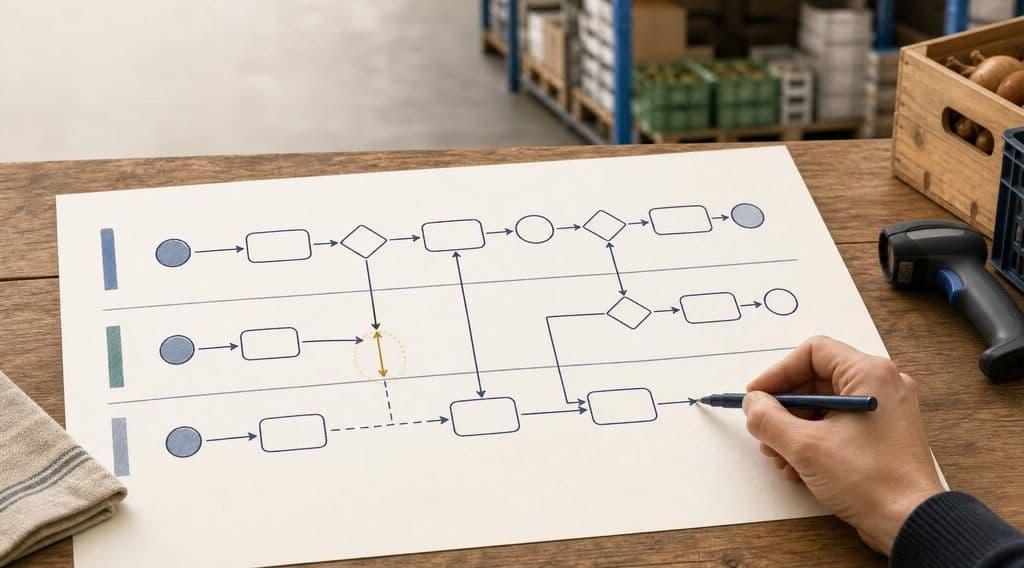
- Make processes clear. Only once the people side has been mapped out can you design the work process the way it really should run. Not a rebuild of the old mess in a new system, but a rethink of what you actually want it to solve.
- Technology last. Only then do you choose your tooling, not the other way round. The software follows the process, and the process follows the people. Do it in that order and you get adoption. Do it the other way round and you get a new CRM that nobody uses.
Two construction companies, two outcomes
Two SMEs from Limburg, both in construction and both with around 40 employees, decided to digitalise their project tracking.
Company A did it the IT way. They bought the best project software on the market, had everything installed, gave two days of training and expected everyone to switch over. Six months later, 30% of the team was using the system. The rest were still working with Excel and WhatsApp groups.
Company B did it differently. For three months they shadowed employees, documented frustrations and mapped out processes. They held workshops where the team itself worked out how it wanted to work. Only then did they choose the technology.
Their implementation took longer. Users were involved step by step and their feedback was taken on board. After six months, 92% of the team was using the system. More importantly, their project tracking had not just been digitalised. It had become fundamentally better.
Why SMEs have the advantage here
For what it's worth, SMEs have an edge over large companies here. The lines are shorter, decisions are quicker and you know people by name. A change programme with 40 people is a different beast from one with 4,000. The problem for SMEs is usually not that change is harder. The problem is that there is nobody internally with the time or the distance to lead it.
The hard truth
Technology has to follow people, not the other way round. But that also means that real digitalisation is harder than an IT project. It takes more time, more patience and more attention to the softer side of change. It's easier to implement a system than to change a culture. But only a change in culture leads to lasting results.
What now?
If after reading this you're thinking 'damn, we treat digitalisation as an IT project too', there's good news: it's never too late to change course.
Start small. Pick one process that your team says every day should be more efficient. Don't go looking for a system straight away. First understand why it doesn't work now, how your team wants it to work and what is needed to make that change.
In the end, digital transformation is about better ways of working, not better systems. That starts with people, not with code.