Blog · Strategy & transformation
After 20 years in IT: why most transformations fail (and what does work)
Twenty years of IT projects, hundreds of SMEs, the same three pitfalls. And a recipe that does work: start with people, win small, grow organically.

An honest confession up front: I've seen more failed transformation projects than successful ones. Twenty years in IT, from tester to programme manager, and hundreds of companies struggling with change. And the same pitfalls every time.
At Make IT So, Jan and I guide Belgian SMEs through their digital transformationHelping your organisation work smarter with technology, not as an IT project but as a way of working.. Not because it's easy; quite the opposite. Rather because after all these years I'm convinced that 1+1 can equal 3, if you follow the right recipe.
Most transformations fail for reasons that have nothing to do with technology. They're about people, processes and, yes, timing too. Here I share what I've learned in twenty years.
The three pitfalls I see again and again
1. The technology-first pitfall
Last month I spoke to an SME owner who proudly showed me his 'digital transformation'. A shiny new ERP systemA single system that brings together core processes such as inventory, accounting and orders., costing 150,000 euros. The problem? Nobody on his team knew how to use it. Three months after implementation, everyone was still working in Excel.
'But Walter, we've digitalised, haven't we?'
No. You've bought expensive software. Digital transformation starts with people, not with systems. Technology is a tool, but it's the people who decide whether the mayonnaise comes together.
2. The big-company-method pitfall
I see it happen again and again: SMEs trying to copy what multinationals do. Coaches promoting methods that work for teams of 200 people but get stuck in an organisation of 20.
It's like raising twins with the methods of a boarding school. The scale is wrong. An SME has different dynamics: shorter lines, more flexibility, but also less budget, fewer specialists and more dependence on a few key people. What works for a multinational doesn't automatically work for your family business of 35 people.
3. The perfect-plan pitfall
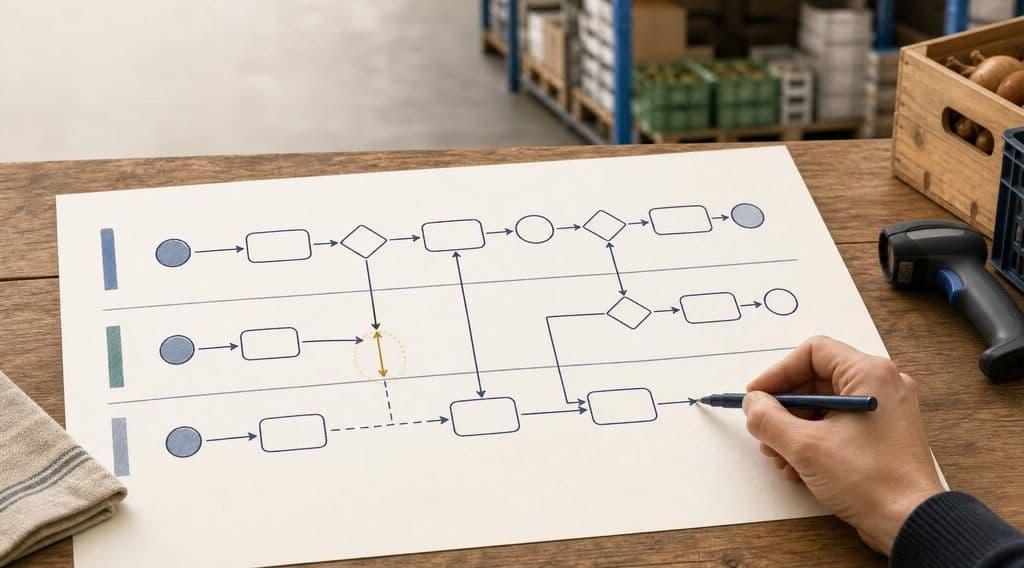
'Walter, we've thought everything through in detail. Look, here's our roadmapA digital roadmap is your step-by-step plan for digitalisation: which steps you take in which order, so you don't have to do everything at once. for the next three years.'
Then the roadmap unrolls. Two metres long. 47 projects, colour-coded by priority, with dependencies that look like a spider's web. It's beautiful. It's also useless.
Transformation isn't a recipe book you follow step by step. It's driving through fog towards the sea. You know where you want to go, but along the way you'll run into obstacles you can't see yet. Then you have to be able to adjust course, go around them, and sometimes take another route. So don't drive too fast until the fog lifts. The plans that do work are simple enough to understand and flexible enough to adapt.
The mayonnaise that did come together: what success stories have in common
Over all those years I've also seen transformations succeed. And each time I recognise the same ingredients. As with mayonnaise, you have to combine the right elements in the right order.
Ingredient 1: start with your people
In every successful transformation I've guided, the owner stood beside their people from day one. Not above them, not opposite them. Beside them.
'Everyone, we're going to do this together. Yes, it will be challenging. Yes, there will be frustration. But we're all pulling in the same direction.'
A client said that at the first team meeting. Six months later, that transformation was one of the smoothest I've ever been part of. Not because there were no problems, but because everyone knew they would solve them together.
Ingredient 2: failing forward
I remember a project at a Belgian wholesaler. Three weeks in, the chosen approach turned out not to work. Instead of muddling on, we stopped. We evaluated. We adjusted.
'Isn't this a waste of time, Walter?' the owner asked.
'On the contrary,' I replied. 'We've just gained three months.'
That's failing forward: make mistakes quickly, learn quickly, adjust quickly. The alternative is spending nine months stuck in an approach you know doesn't work. So try as soon as you can, evaluate, adjust, evaluate again, and keep going.
Ingredient 3: organic growth
The best transformations grow like a tree, not like a building. You don't build a transformation from the ground up according to a blueprint. You let it grow from what's already there, step by step, with respect for what works.
A client wanted to digitalise his entire business. Instead of tackling everything at once, we started with pain point number one: following up quotes. A small system, a small team, a small win. But one that everyone could see. Six months later, that same team came to ask us: 'Walter, can we do this for our invoice follow-up too?' The transformation had grown organically, from the inside out.
So what does getting the best result look like?
After twenty years I know that successful transformation is actually simple. Not easy, but simple. Five steps:
- Start by listening. Before you install a single system, sit down with the people involved. What frustrates them? Where do they lose time? What would they change if they had a magic wand?
- Choose one pain point. Not five. Not three. One. The most important, the most visible, the most achievable. Solve that.
- Make sure there are visible wins. Within three months, everyone in the company should be able to say: 'Oh yes, that project of Walter's. That really does work better now.'
- Build on success. Only when step three really works do you move on to the next challenge. Not before. Not in parallel.
- Repeat. Transformation isn't a project with an end date. It's a way of working that you build into your organisation.
A final thought
Seven years ago I faced a transformation of my own. A tumour turned my life upside down. And do you know what I learned during my recovery? Everything comes right, given time and patience.
Not with stress. Not with haste. Not with perfect plans. But with patience, step by step, and the confidence that you're on the right path. Combined with the perseverance to simply do what needs doing.
The same goes for your business. Transformation isn't a sprint. It's a marathon you run with your team. And the teams that finish together are the teams that set off together.
Sound familiar?
If you're reading this and thinking 'that sounds like our company', you're not alone. Almost every SME we work with faces the same challenges. The question is: are you ready to approach things differently?
At Make IT So we help Belgian SMEs to transform in a human way. No fuss and no impossible promises, just experience that works. Because I still believe that 1+1 equals 3, if you combine the right ingredients.
Curious where your transformation stands today? A quickscan helps you pin down your biggest pain point in 10 minutes, and then we'll take it from there. No obligations, no sales pitch. Just a conversation between business owners who understand what you're dealing with.